
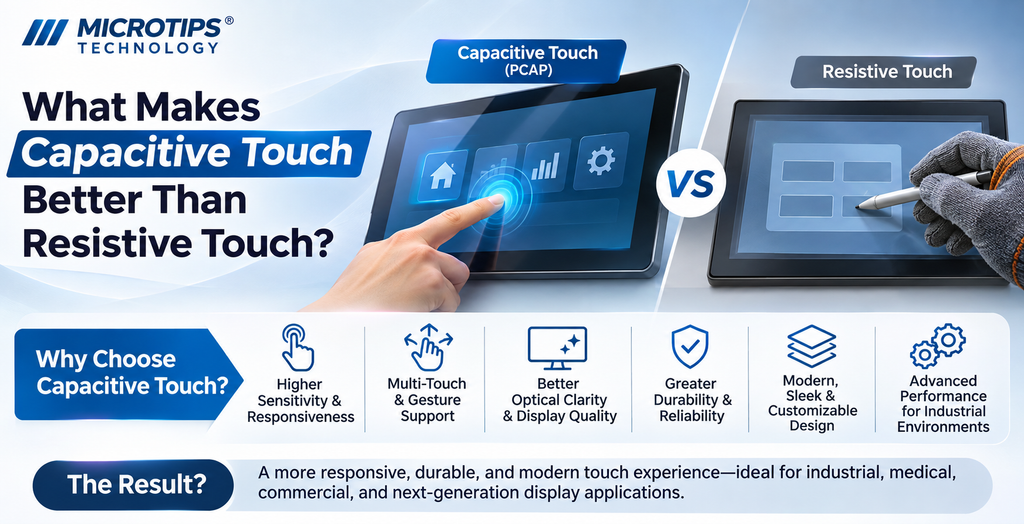
Choosing the right touchscreen technology can make all the difference in product performance, durability, and user experience. When designing industrial equipment, medical devices, smart home systems, or consumer electronics, one important decision is whether to use a capacitive or resistive touchscreen.
While both technologies have their advantages, capacitive touchscreens have become a preferred choice for many modern display applications thanks to their responsiveness, multi-touch capabilities, optical clarity, and sleek design.
But what exactly makes capacitive touch technology better than resistive touch? Let’s explore the key differences and how to select the best touchscreen solution for your application.
Understanding Capacitive vs. Resistive Touch Technology
Capacitive Touchscreen
Detects changes in an electrical field caused by a finger or compatible conductive input.
Resistive Touchscreen
Uses pressure to bring conductive layers into contact and register an input.
Capacitive touchscreens, particularly projected capacitive (PCAP) touchscreens, detect changes in capacitance when a finger or compatible stylus approaches or touches the sensor. This enables smooth, accurate touch interaction without requiring significant pressure.
Resistive touchscreens operate through physical pressure applied to flexible layers. They can be activated using fingers, gloves, or nonconductive styluses, making them suitable for certain industrial and specialized environments.
Although resistive technology remains valuable, capacitive touch offers several advantages for applications requiring a modern, intuitive user interface.
6 Key Advantages of Capacitive Touchscreens
1. Superior Touch Sensitivity and Responsiveness
Capacitive touchscreens deliver fast, responsive interaction with minimal physical pressure. Users can navigate menus, select functions, and interact with graphical interfaces effortlessly.
This makes capacitive technology ideal for industrial human-machine interfaces (HMIs), medical equipment, smart appliances, and interactive control panels.
2. Multi-Touch and Gesture Support
One of the biggest advantages of projected capacitive touch technology is its ability to support multiple simultaneous touch points.
Unlike conventional resistive touchscreens, PCAP technology enables intuitive gestures such as pinch-to-zoom, swiping, scrolling, and multi-finger controls.
These features enhance usability and support more sophisticated user interface designs.
3. Better Optical Clarity and Display Quality
Capacitive touchscreens commonly use transparent glass-based sensor structures that provide excellent optical clarity.
Compared with traditional resistive touch panels, which typically incorporate additional flexible layers, capacitive solutions can offer improved light transmission and image visibility.
When paired with high-resolution TFT LCD displays and optical bonding, capacitive touch technology can deliver vibrant images, improved readability, and a premium viewing experience.
4. Enhanced Durability and Long-Term Reliability
Because capacitive touchscreens do not rely on flexible layers being pressed together, they avoid certain mechanical wear mechanisms associated with resistive touch technology.
Their glass surfaces can also provide excellent resistance to scratches and repeated interaction, depending on the cover-glass design.
This makes capacitive touchscreens an attractive option for frequently used industrial displays, commercial equipment, and interactive kiosks.
5. Modern, Sleek, and Customizable Design
Capacitive touch technology supports edge-to-edge glass designs, streamlined control panels, and visually appealing interfaces.
Manufacturers can customize cover-glass dimensions, thickness, printing, surface treatments, and bonding methods to meet specific product requirements.
For OEMs developing next-generation equipment, capacitive touchscreens offer greater flexibility in creating attractive, integrated display assemblies.
6. Advanced Touch Performance for Specialized Environments
Modern PCAP touch controllers can be configured to support glove operation, moisture tolerance, and improved resistance to electrical interference.
With appropriate sensor design, controller tuning, and system integration, capacitive touchscreens can perform reliably in demanding industrial and commercial environments.
However, performance with thick gloves, standing water, and harsh electrical conditions depends on the specific touchscreen design and should be validated for each application.
Capacitive vs. Resistive Touchscreen: Quick Comparison
| Feature | Capacitive Touch | Resistive Touch |
| Touch activation | Electrical capacitance | Physical pressure |
| Touch sensitivity | High | Requires pressure |
| Multi-touch | Common with PCAP | Limited in conventional designs |
| Optical clarity | Typically higher | Typically lower |
| Surface durability | Often excellent with glass | Flexible top layer subject to wear |
| Glove compatibility | Requires compatible design/tuning | Works with most gloves |
| Stylus support | Compatible capacitive stylus | Most stylus types |
| Cost | Often higher | Often lower |
| Best suited for | Modern HMIs, medical, smart devices | Basic controls, legacy industrial systems |
When Is Resistive Touch Still the Better Choice?
Although capacitive touch offers many advantages, resistive touchscreens are still practical for applications requiring operation with thick gloves, nonconductive styluses, or simple pressure-based controls.
They can also provide a cost-effective solution for equipment where multi-touch functionality and premium optical performance are not essential.
Ultimately, the best technology depends on environmental conditions, user interaction requirements, cost targets, and product design.
Why Choose Microtips Technology for Capacitive Touchscreen Solutions?
At Microtips Technology https://microtipsusa.com/ , we understand that selecting the right touchscreen is about more than touch sensitivity. It is about creating a reliable, efficient, and user-friendly display solution tailored to your application.
We offer customizable touchscreen and display solutions for industrial, medical, commercial, and embedded applications.
Our capabilities include:
- Projected capacitive (PCAP) and resistive touch panel solutions
- Custom cover glass, mechanical dimensions, and touch interfaces
- TFT LCD integration with capacitive touchscreens
- Optical bonding and air bonding options
- Touch controller selection and application-specific integration
- Custom display solutions for OEM and industrial applications
Whether you are upgrading an existing resistive touchscreen or developing a new product with advanced capacitive touch functionality, our team can help identify a suitable solution for your performance, mechanical, and budget requirements.
Final Thoughts: Is Capacitive Touch the Right Choice?
Capacitive touchscreens have transformed the way users interact with electronic devices. Their high sensitivity, multi-touch functionality, improved optical clarity, and modern design make them an excellent choice for many next-generation products.
While resistive touchscreens remain useful in specialized applications, projected capacitive touch technology is often the preferred solution when user experience, display quality, and design flexibility are top priorities.
Looking for a custom capacitive touchscreen or TFT LCD display solution?
Contact Microtips Technology https://microtipsusa.com/ today to discuss your project requirements, explore customization options, or request a quote.
Visit https://microtipsusa.com/ for more details.
Custom Display Solutions | Capacitive Touchscreens | Industrial TFT LCD Displays