
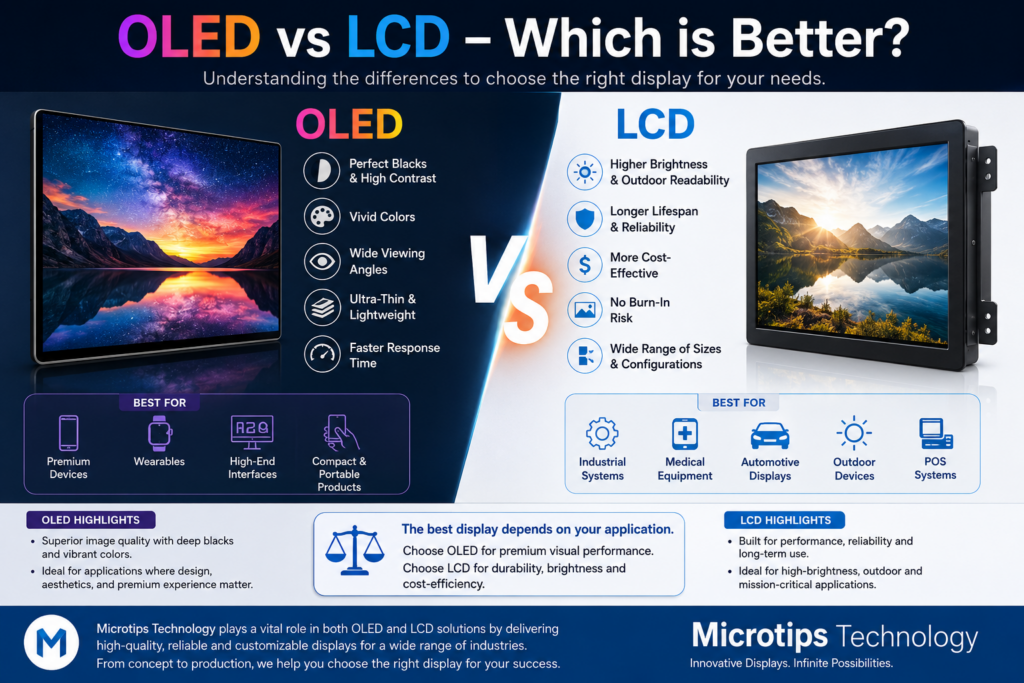
Display technology continues to evolve rapidly, and two of the most widely used technologies today are OLED and LCD. Both offer unique advantages depending on the application, environment, and performance requirements. Understanding the differences between OLED and LCD can help businesses and consumers choose the right display solution for their needs.
What is LCD?
LCD (Liquid Crystal Display) technology uses a backlight to illuminate liquid crystals that create images on the screen. LCDs are commonly used in industrial equipment, medical devices, automotive applications, consumer electronics, and many other products.
Advantages of LCD Displays
- Excellent brightness for outdoor and sunlight-readable applications
- Long lifespan and stable performance
- Lower cost for larger production volumes
- Reduced risk of image burn-in
- Available in a wide variety of sizes and configurations
Best Applications for LCD
LCD displays are ideal for:
- Industrial control systems
- Medical equipment
- Automotive displays
- POS systems
- Outdoor devices
- Long-operating applications
What is OLED?
OLED (Organic Light Emitting Diode) technology allows each pixel to emit its own light without requiring a backlight. This results in deeper blacks, higher contrast ratios, and vibrant image quality.
Advantages of OLED Displays
- Superior contrast with true black levels
- Ultra-thin and lightweight design
- Faster response times
- Wide viewing angles
- Rich and vivid colors
Best Applications for OLED
OLED displays are ideal for:
- Premium consumer electronics
- Wearable devices
- High-end user interfaces
- Compact portable products
- Applications requiring excellent visual aesthetics
OLED vs LCD – Key Differences
| Feature | OLED | LCD |
| Brightness | Moderate | Higher brightness available |
| Contrast Ratio | Excellent | Good |
| Black Levels | True black | Backlight glow possible |
| Power Consumption | Lower for dark content | More consistent power usage |
| Lifespan | Shorter in some applications | Longer overall lifespan |
| Cost | Higher | More cost-effective |
| Burn-In Risk | Possible | Minimal |
| Outdoor Visibility | Moderate | Excellent with transflective/high-brightness options |
Which is Better?
The answer depends on the application.
If you need:
- Higher brightness
- Longer operational life
- Cost efficiency
- Outdoor readability
Then LCD is often the better solution.
If you prioritize:
- Premium image quality
- Deep blacks
- Thin form factor
- High visual appeal
Then OLED may be the better choice.
Both technologies have strengths, and selecting the right display depends on the product environment, performance expectations, and budget.
At the end of the day, the best display is the one that fits your application requirements perfectly.
Microtips Technology https://microtipsusa.com/ plays an important role in both OLED and LCD display solutions by providing high-quality, reliable, and customizable display technologies for a wide range of industries. From vibrant OLED displays with superior contrast and sleek designs to durable LCD displays built for industrial and outdoor applications, Microtips Technology https://microtipsusa.com/ helps customers choose the right solution based on performance, environment, and application needs. With strong engineering support and advanced display expertise, Microtips Technology https://microtipsusa.com/ continues to deliver innovative display solutions for today’s evolving technology market.