
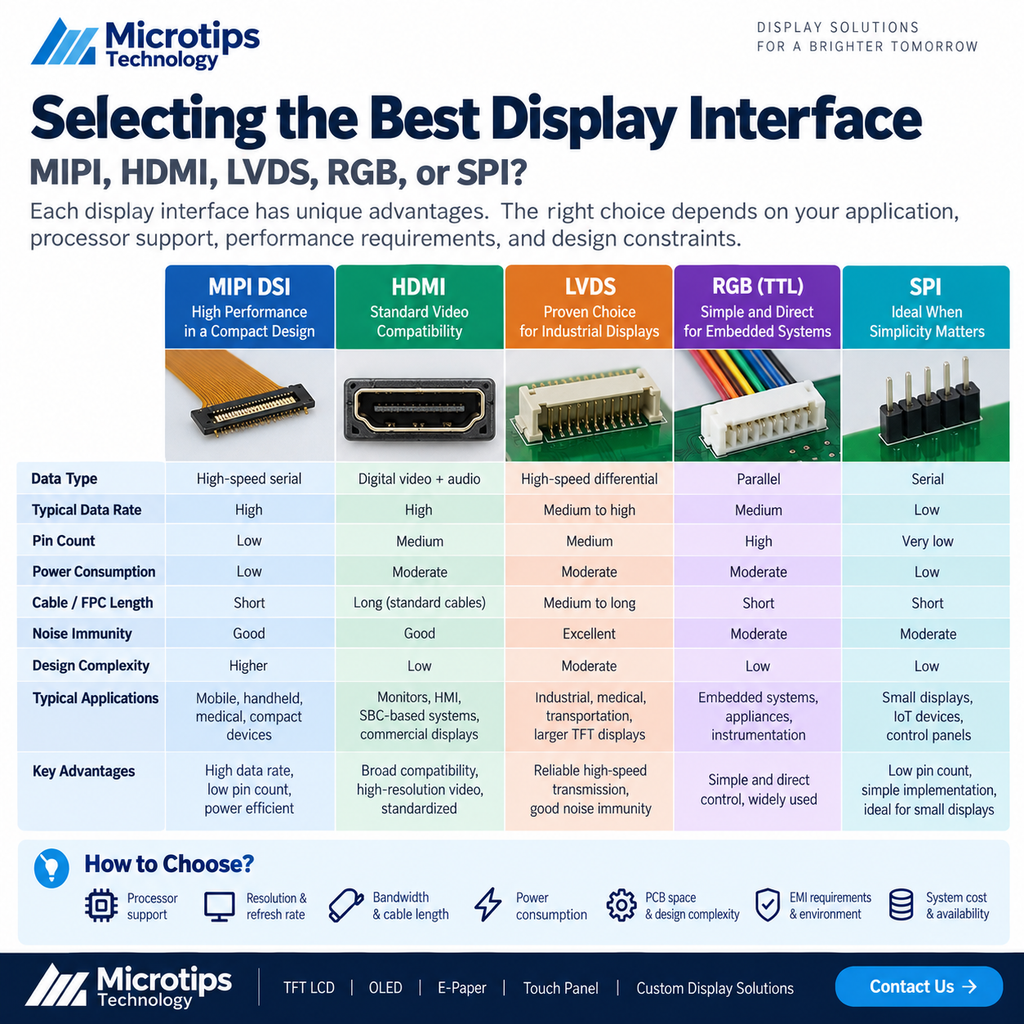
Choosing the right display for your product involves more than selecting the correct size, resolution, brightness, and touch technology. The display interface is equally important because it determines how image data is transferred from the processor or controller to the display.
Common display interfaces include MIPI, HDMI, LVDS, RGB, and SPI. Each has different advantages in terms of bandwidth, pin count, power consumption, design complexity, cable length, and cost.
At Microtips Technology, we work with customers to select and customize display solutions based on their electrical, mechanical, optical, and environmental requirements. Understanding the differences between these interfaces is an important first step.
MIPI DSI – High Performance in a Compact Design
MIPI DSI (Display Serial Interface) is widely used in smartphones, tablets, handheld equipment, wearables, medical devices, and other compact embedded products.
MIPI uses high-speed serial communication, allowing large amounts of display data to be transmitted using relatively few signal lines. This makes it especially attractive for products where PCB space, connector size, and power consumption are important considerations.
Best suited for: Compact devices, high-resolution displays, battery-powered products, handheld equipment, and applications with processors that provide native MIPI DSI support.
Key advantages: High data rates, low pin count, compact connections, and good power efficiency.
The main consideration is design complexity. The host processor must support the appropriate MIPI implementation, and signal integrity becomes increasingly important as data rates rise.
HDMI – Convenient for Standard Video Sources
HDMI (High-Definition Multimedia Interface) is one of the most recognizable display interfaces. It is commonly used when a display needs to connect to a PC, single-board computer, media system, industrial computer, or another standard video source.
Unlike many embedded display interfaces, HDMI is designed as an external multimedia connection and can carry both digital video and audio.
Best suited for: Industrial monitors, HMI systems, test equipment, commercial displays, development platforms, and products requiring compatibility with standard HDMI video sources.
Key advantages: Broad compatibility, high-resolution video support, standardized connectivity, and relatively straightforward system integration.
For an embedded TFT LCD that does not natively accept HDMI, an HDMI receiver or controller board may be required to convert the signal into the interface used by the LCD panel.
LVDS – A Proven Choice for Industrial Displays
LVDS (Low-Voltage Differential Signaling) has been widely used for medium- and larger-size TFT LCDs in industrial, medical, transportation, instrumentation, and commercial applications.
LVDS transmits data using differential signal pairs, providing reliable high-speed communication with good noise immunity.
Best suited for: Industrial equipment, medical systems, larger TFT displays, embedded computers, and applications where reliable video transmission is important.
Key advantages: Good noise immunity, established technology, relatively high data rates, and reliable performance in industrial environments.
LVDS remains a practical choice for many embedded applications, although newer platforms and higher-resolution displays increasingly use interfaces such as MIPI DSI or eDP.
RGB – Simple and Direct for Embedded Systems
The RGB parallel interface, sometimes called TTL RGB, sends pixel information over multiple parallel data lines. Depending on the implementation, it may use RGB565, RGB666, RGB888, or another configuration.
RGB interfaces are common in embedded TFT LCD applications where the processor or microcontroller includes a compatible LCD controller.
Best suited for: Embedded systems, industrial controls, appliances, instrumentation, and low-to-medium resolution TFT displays.
Key advantages: Straightforward architecture, direct display control, predictable operation, and wide availability on embedded TFT modules.
The tradeoff is the number of connections required. Because data is transmitted in parallel, RGB typically requires significantly more signal lines than serial interfaces such as MIPI or SPI.
SPI – Ideal When Simplicity Matters
SPI (Serial Peripheral Interface) is popular with smaller LCDs, OLEDs, and other embedded display modules.
Because SPI requires relatively few signal lines, it can simplify PCB routing and reduce connector requirements. However, its lower effective display bandwidth compared with high-speed video interfaces makes it less suitable for large, high-resolution displays requiring rapid screen updates.
Best suited for: Small displays, IoT devices, control panels, instrumentation, status displays, and microcontroller-based products.
Key advantages: Low pin count, simple implementation, compatibility with many microcontrollers, and reduced PCB complexity.
For applications displaying mostly text, icons, menus, or slowly changing graphics, SPI can be an excellent solution.
How Do You Choose the Right Interface?
There is no single interface that is best for every display application. The correct choice depends on the complete system design.
| Interface | Typical Strength | Common Applications |
| MIPI DSI | High speed with low pin count | Mobile, handheld, medical, compact embedded devices |
| HDMI | Standard video compatibility | Monitors, HMI, PCs, SBC-based systems |
| LVDS | Reliable high-speed transmission | Industrial, medical, larger TFT displays |
| RGB | Direct embedded display control | Appliances, controls, embedded TFT systems |
| SPI | Simple, low-pin-count communication | Small displays, IoT, instrumentation |
When evaluating an interface, engineers should consider the host processor, display resolution, refresh rate, available bandwidth, cable or FPC length, EMI requirements, PCB space, connector limitations, power consumption, and overall system cost.
Compatibility with the processor is particularly important. Choosing a display with an interface already supported by the host platform can significantly simplify development and reduce the need for additional bridge ICs or controller boards.
Microtips Technology https://microtipsusa.com/ Can Help
Selecting the right display interface is only one part of developing the right display solution.
Microtips Technology https://microtipsusa.com/ offers TFT LCD, OLED, E-Paper, touch panel, high-brightness, optical bonding, cover glass, and customized display solutions for a wide range of industrial and commercial applications.
Depending on your project requirements, we can help evaluate factors including:
- Display size and resolution
- MIPI, HDMI, LVDS, RGB, SPI, and other interface requirements
- Brightness and sunlight readability
- Capacitive or resistive touch
- Cover glass and optical bonding
- Operating temperature
- Mechanical dimensions and custom FPC designs
- Connector and pinout requirements
- Long-term product availability
Whether you are designing a new product or looking for an alternative to an existing display, choosing the correct interface early in the development process can help reduce design complexity, development time, and unnecessary system cost.
Looking for the right display for your next project? Contact Microtips Technology https://microtipsusa.com/ with your display specifications, application, annual usage, and interface requirements, and our team can help identify the best solution.