
A Complete Guide from Microtips Technology
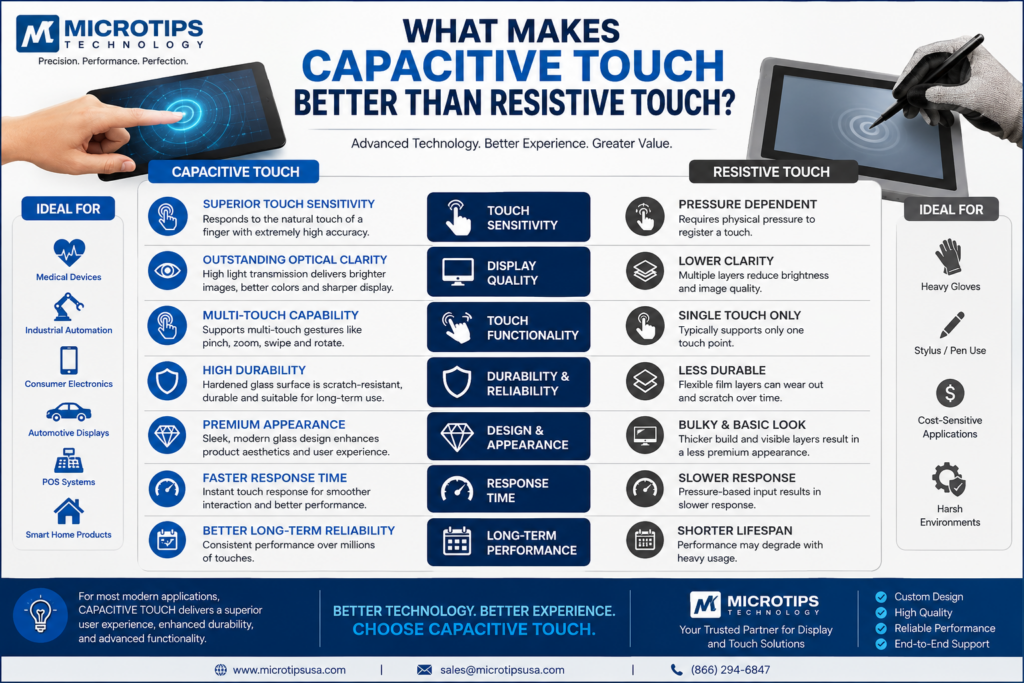
Touchscreen technology has become an essential part of modern electronic devices, from medical equipment and industrial controls to consumer electronics and automotive displays. When selecting the right touchscreen, one of the most common questions is: Should you choose a capacitive touch screen or a resistive touch screen?
While both technologies have their place, capacitive touch screens have become the preferred choice for most modern applications due to their superior performance, durability, and user experience.
Here’s why.
Understanding the Difference
Before comparing them, it’s important to understand how each technology works.
Capacitive Touch Screens
Capacitive touch screens detect changes in the electrical field created by the human body. When a finger touches the screen, it alters the electrostatic field, allowing the controller to determine the exact touch location.
Resistive Touch Screens
Resistive touch screens consist of two flexible conductive layers separated by a small gap. Pressure causes the layers to make contact, registering the touch.
Because resistive technology relies on pressure rather than electrical conductivity, it can be operated with a finger, stylus, or even while wearing thick gloves.
Why Capacitive Touch Is Better
1. Superior Touch Sensitivity
Capacitive touch screens require only a light touch. Users enjoy a smooth, responsive experience similar to modern smartphones and tablets.
Resistive screens require physical pressure, making navigation feel slower and less natural.
Result:
- Faster operation
- Better user experience
- Reduced user fatigue
2. Outstanding Optical Clarity
Resistive touch screens contain multiple layers that can slightly reduce brightness and image quality.
Capacitive touch panels are made with transparent glass, allowing significantly higher light transmission.
Benefits include:
- Brighter images
- Better color reproduction
- Sharper graphics
- Improved readability
This makes capacitive touch ideal for TFT LCD displays with high-resolution graphics.
3. Multi-Touch Functionality
One of the biggest advantages of capacitive technology is support for multi-touch gestures.
Users can:
- Pinch-to-zoom
- Swipe
- Rotate images
- Use multiple fingers simultaneously
Resistive touch screens typically support only a single touch point.
For modern user interfaces, multi-touch capability has become an expected feature.
4. Greater Durability
Capacitive touch screens use hardened glass surfaces that are highly resistant to:
- Scratches
- Daily wear
- Chemicals
- Repeated cleaning
Resistive touch screens use flexible plastic films that can wear out over time.
For applications requiring long service life, capacitive touch is often the better investment.
5. Premium Appearance
Consumers associate glass capacitive touch screens with premium products.
The sleek edge-to-edge glass design creates a modern appearance suitable for:
- Medical equipment
- Industrial controls
- Smart appliances
- Point-of-sale terminals
- Automotive displays
A premium interface often enhances the perceived value of the entire product.
6. Faster Response Time
Capacitive touch controllers can register touch almost instantly.
This creates:
- Smoother scrolling
- Faster menu navigation
- Improved gesture recognition
- Better overall performance
For interactive applications, responsiveness can significantly improve the user experience.
7. Better Long-Term Reliability
Because capacitive touch screens contain fewer moving layers, they generally maintain consistent performance over millions of touches.
This makes them an excellent choice for high-traffic environments such as:
- Hospitals
- Kiosks
- Retail systems
- Manufacturing equipment
- Transportation systems
When Resistive Touch Still Makes Sense
Although capacitive technology offers many advantages, resistive touch remains valuable in certain applications.
Resistive touch may be preferred when:
- Users wear heavy work gloves
- Precision stylus input is required
- Budget is the primary concern
- Operation in harsh environments requires pressure-based input
Selecting the right technology depends on your application’s requirements rather than assuming one solution fits every use case.
Which Industries Benefit Most from Capacitive Touch?
Capacitive touch screens are widely used across industries, including:
- Medical devices
- Industrial automation
- Consumer electronics
- Smart home products
- Automotive displays
- Point-of-sale (POS) systems
- Marine electronics
- Test and measurement equipment
- Building automation
- Security systems
As user expectations continue to evolve, capacitive touch technology is becoming the standard for next-generation human-machine interfaces (HMIs).
Why Choose Microtips Technology?
At Microtips Technology https://microtipsusa.com/, we design and manufacture custom display solutions tailored to the unique requirements of each application. Whether your project requires Projected Capacitive (PCAP) touch, resistive touch, TFT LCDs, OLED displays, monochrome LCDs, or fully integrated display assemblies, our engineering team works closely with customers to deliver reliable, high-performance solutions.
From custom cover glass and optical bonding to sunlight-readable displays and glove-compatible touch solutions, Microtips Technology provides the expertise and support needed to bring innovative products to market.
Final Thoughts
Both capacitive and resistive touch technologies have their strengths, but for most modern applications, capacitive touch offers a superior user experience, enhanced durability, improved display clarity, and advanced multi-touch capabilities. As industries continue to demand faster, smarter, and more intuitive interfaces, capacitive touch has become the preferred solution for today’s electronic devices.
If you’re developing a new product or upgrading an existing design, partnering with Microtips Technology https://microtipsusa.com/ can help you choose the ideal touchscreen solution to meet your performance, environmental, and budget requirements. Try a Microtips’ Display, https://microtipsusa.com/ and see how we can make your product more usable and better looking!